


The History of Mullein
If you've ever walked along a Virginia roadside and spotted a towering, silver-green stalk crowned with yellow flowers, you've likely crossed paths with mullein. Growing up to eight feet tall, with leaves as soft as flannel, mullein (Verbascum thapsus) has been a presence in Virginia for centuries. Its story is inseparable from the people who recognized its power — especially Indigenous peoples and African Americans.

Where Mullein Comes From
Mullein is native to Europe, northern Africa, and central Asia, where it has been valued as a healing herb for thousands of years. The Greek physician Dioscorides recommended it for pulmonary diseases nearly 2,000 years ago, and it appears in medieval European herbals as a remedy for coughs, swellings, and inflammation. Its name is thought to derive from the Latin word for "soft," a reference to its famously velvety leaves.
The plant arrived in North America with European colonizers. Historians and botanists trace its first recorded introduction in the Americas directly to Virginia in the mid-1700s, when colonial settlers brought it over, ironically, as a piscicide, a substance used to stun fish for easier catching. From that foothold in Virginia's soil, mullein spread across the continent. By 1818, it had become so well established on the East Coast that botanists were mistaking it for a native plant. By 1839 it reached the Midwest, and by 1876 it had naturalized along the Pacific Coast.

Indigenous Knowledge: Learning the New Plant
Though mullein was not native to North America, Indigenous peoples quickly recognized its healing properties and folded it into their own rich traditions of plant medicine. Tribes across the Eastern Woodlands — including the Cherokee, Creek, Delaware, and Iroquois — adopted mullein and integrated it into their healing practices with remarkable depth.
The most common use was for respiratory ailments. Tribes brewed the leaves and flowers into teas or syrups for coughs, croup, and chest congestion. The Cherokee, whose territory once stretched into the Virginia mountains, used dried mullein leaves as a smoke therapy — burning them to relieve congestion and ease breathing difficulties from asthma. They also wrapped the large leaves around the throat to treat swollen glands and mumps. The Delaware heated leaf poultices and pressed them to aching joints as a remedy for rheumatism. Cherokee healers also boiled the roots into a paste for inflamed limbs and joints.
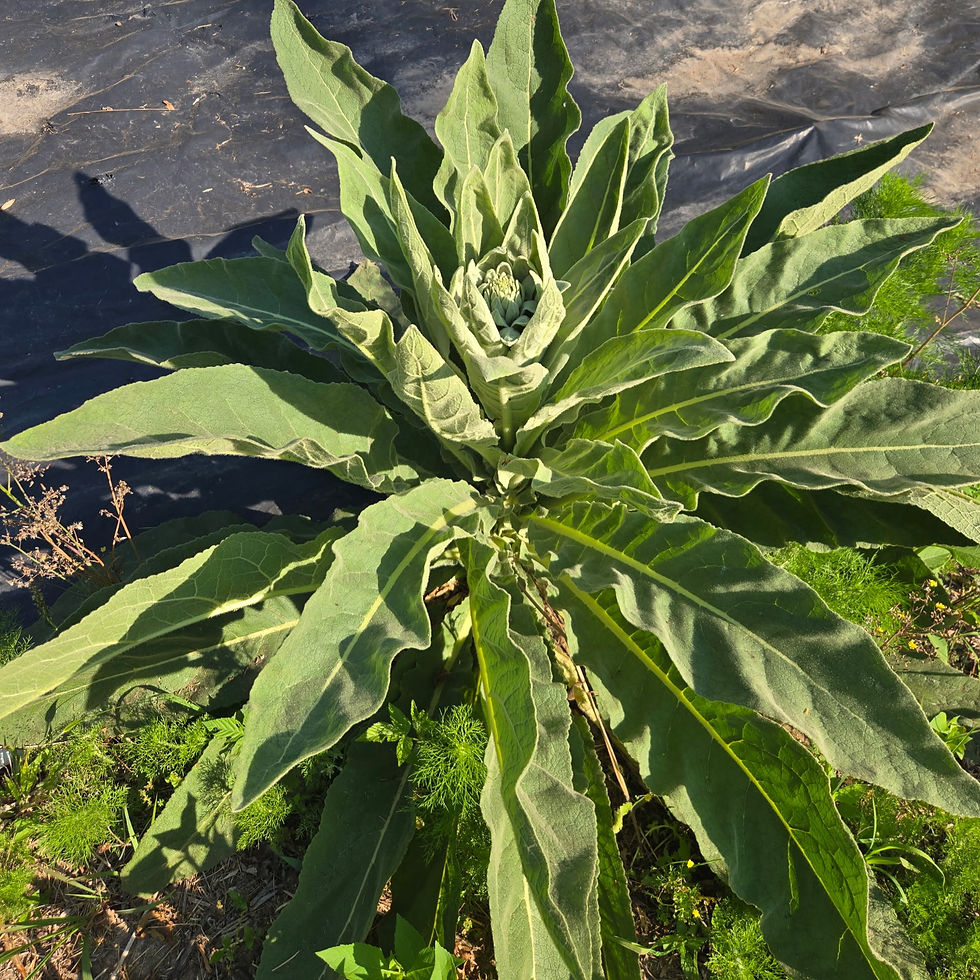
Mullein's practical uses extended beyond medicine. Its extraordinarily soft leaves were used to line moccasins for warmth and comfort. Some nations are also said to have used the leaves to apply body paint. The tall, dried stalks — long used in Europe as torches — held similar utility for Indigenous peoples as a fire-starting material.
African American Herbalism
Enslaved Africans brought with them a tradition of plant-based medicine rooted in West and Central African healing practices. When they arrived in Virginia and the broader American South, they found themselves in an unfamiliar landscape, with almost no access to formal medical care. Healers within enslaved communities, usually women, became the primary caregivers on plantations, blending their African botanical knowledge with what they learned from Indigenous peoples and what they observed growing in the fields around them.
Mullein — tall, recognizable, and abundantly available in Virginia's disturbed soils and roadsides — became one of their most relied-upon plant allies. It was used widely in African American healing traditions for respiratory ailments. The leaves were prepared as tea, used in healing baths and soaks for joint pain, and applied as poultices. Mullein's anti-inflammatory properties made it valuable for arthritis and gout as well.
George Washington Carver, the pioneering Black botanist and healer, spoke of mullein with reverence: "Mullein is one of the oldest of our medicinal plants and is a noted remedy for all kinds of coughs and colds, rheumatic troubles, stopping of blood, asthmatic affections, and all manner of things that human ills are heir to. The flowers are especially valuable in aggravated cases of earaches."
For enslaved Africans, knowing how to heal was to hold a form of power that could not be stripped away. Practicing healing traditions connected people to something larger than their bondage.
The colonial and plantation power structure recognized this threat. In October 1748, the Virginia General Assembly passed Act XXXVIII which made it illegal for enslaved people to prepare or administer medicine. By the mid-18th century, both Virginia and South Carolina had made it a capital offense for enslaved people to teach or learn about herbal medicine.
Despite suppression, this knowledge survived. It was passed person to person, whispered in quarters, shared in the hidden garden patches that enslaved people cultivated alongside their food crops.
A Plant That Belongs to Everyone — But Not Equally
Today, mullein grows freely across every county in Virginia. You'll find it on roadsides, in old fields, along fence rows, and in the disturbed margins of forests — exactly the kinds of places where working people have always walked and gathered. That accessibility is part of what made it so vital to communities who were systematically denied access to formal healthcare.
As interest in herbal medicine has surged in recent decades, mullein has enjoyed a remarkable revival in mainstream wellness culture — appearing in teas, tinctures, supplements, and herbal smoke blends.
Still Growing, Still Healing
Mullein is classified today as a non-native, naturalized plant in Virginia — neither native nor wholly foreign, but woven into this landscape through centuries of shared history.
The next time you see a mullein stalk rising from the roadside — and you will, anywhere in Virginia — consider what it carries. A history that crosses continents. A medicine that outlasted suppression. And a legacy of knowledge born from the wisdom, resilience, and ingenuity of the people who called this land home.


What a respect-full acknowledgement of the non-native roadside plant familiar to most. The plant kindom has wonderful lessons to teachus all.
Thank you.